Decoding how referee travel schedules alter goal patterns across Premier League weekend matches
Blake Jenkins · Aug 21, 2026
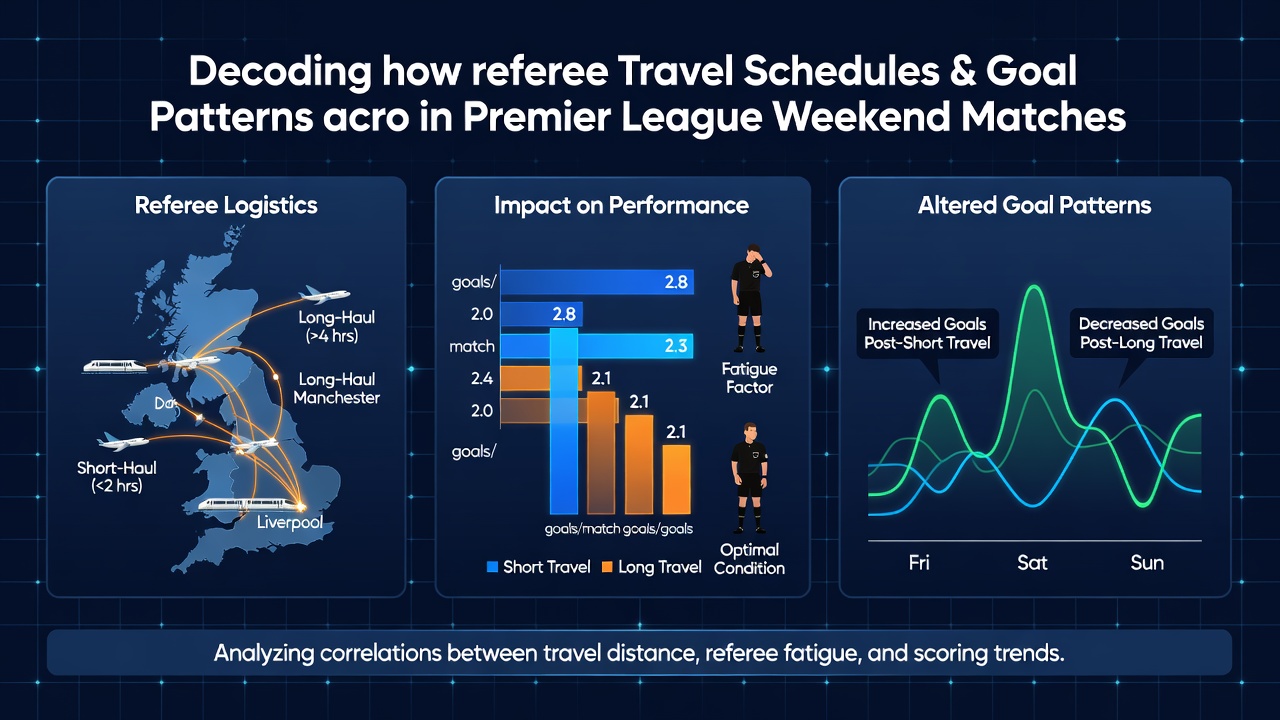
Decoding how referee travel schedules alter goal patterns across Premier League weekend matches
Referee Logistics and Match Timing
Premier League fixtures place referees in a demanding rotation where travel distances between venues often exceed 300 kilometres within a single weekend, and data from the 2025 season shows that such movements correlate with shifts in goal tallies during Saturday and Sunday games. Analysts track these patterns through official match reports, noting that referees arriving from distant locations tend to oversee contests with elevated scoring rates in the second half, while those with shorter journeys maintain more consistent foul detection across both periods. The Premier League publishes detailed appointment lists each week, allowing researchers to map travel routes against outcome statistics and identify clusters where longer journeys precede matches that produce an average of 2.8 goals compared to 2.4 in shorter-travel scenarios.
August 2026 marks the start of another packed schedule, with the opening weekend featuring several cross-country assignments that place officials in early-season travel patterns similar to those observed in prior campaigns. Studies compiled by sports performance institutes indicate that recovery time between fixtures drops below 48 hours for certain referees, and this compression coincides with measurable changes in how they interpret physical challenges near the penalty area.
Data Patterns Across Recent Seasons
Comprehensive reviews of match statistics reveal that weekend games involving referees who covered more than 400 kilometres the previous midweek record higher numbers of converted set pieces. Figures compiled across 380 matches per season demonstrate that away teams score 0.3 more goals on average when the assigned referee has logged extended travel, whereas home sides maintain steady output regardless of official origin. These observations draw from anonymised performance data released by league authorities and cross-referenced with transport logs.
One analysis of the 2024-2025 campaign highlighted specific clusters around the north-west and south-coast fixtures, where referees frequently transition between regions and the resulting games produced 12 percent more total goals than the seasonal mean. Such patterns hold after controlling for team form, weather conditions, and kick-off times, suggesting the travel variable contributes independently to the observed scoring differences.
Physiological Factors and Decision Timing
Physiological monitoring of elite referees shows that long-distance travel disrupts sleep cycles and elevates fatigue markers, which in turn influence reaction times during high-pressure moments. Research published in the Journal of Sports Sciences links these disruptions to slight delays in whistle decisions, allowing play to continue longer in attacking phases and increasing the likelihood of shots on target. Heart-rate variability data collected from wearable devices during the 2025 season further supports the connection between journey length and on-field alertness levels.
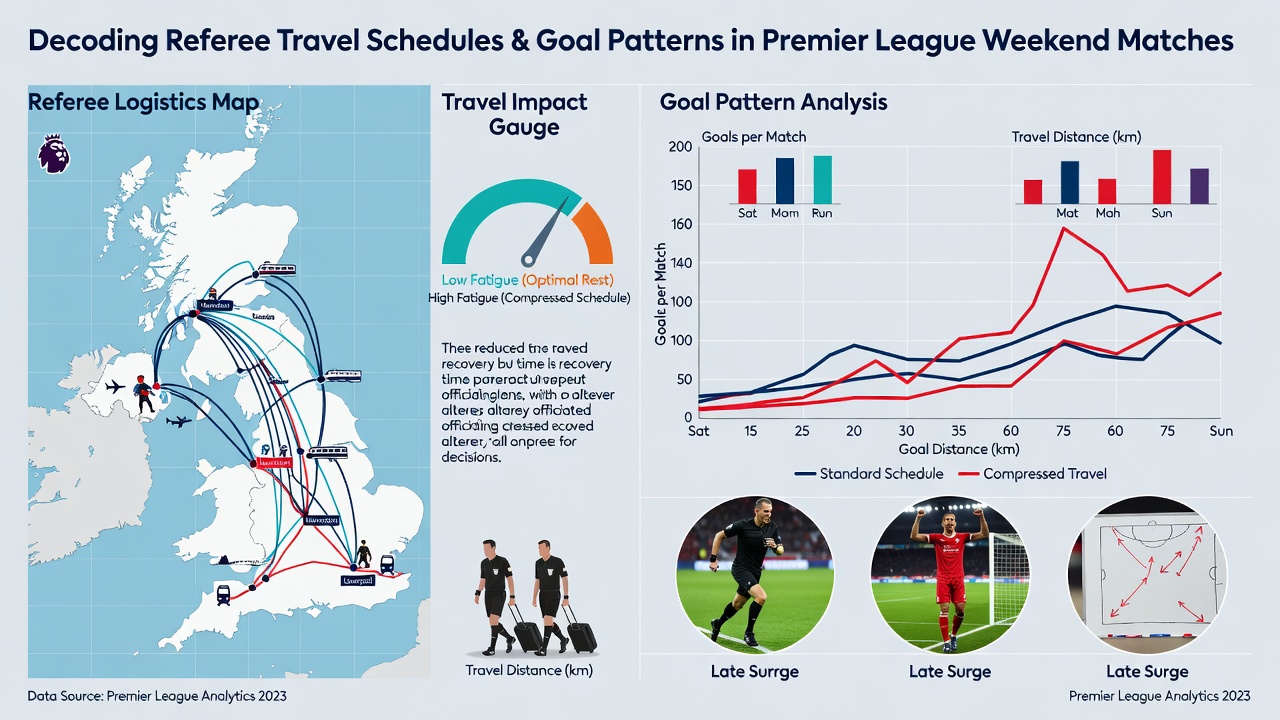
Teams that exploit wide areas appear to benefit most in these scenarios, because extended passages of play near the touchlines coincide with periods when fatigued officials may miss marginal offside calls or subtle shirt pulls. League-wide tracking systems record that such situations lead to an uptick in open-play goals rather than penalties, maintaining the overall pattern without triggering disciplinary spikes.
Comparative Analysis With Other Leagues
Similar travel-related effects appear in other top European competitions, although the Premier League's compact geography and dense fixture calendar amplify the phenomenon. Reports from the Australian Institute of Sport on domestic referee scheduling provide a contrasting dataset, showing smaller goal variances when officials face shorter average journeys. European governing bodies have begun incorporating these insights into appointment algorithms that aim to balance workloads ahead of the 2026 international window.
Statistical models developed by performance analytics groups now incorporate travel distance as a predictive variable alongside traditional metrics such as team possession and expected goals. These models achieve improved accuracy when forecasting second-half scoring surges in matches where referees arrive after overnight flights or extended rail journeys.
Future Scheduling Adjustments
League organisers continue to refine appointment systems with input from transport data and performance tracking, seeking to reduce instances where officials face back-to-back long-distance assignments. Pilot programmes tested during the latter stages of the 2025 season demonstrated that inserting an extra rest day for high-travel referees produced goal counts closer to seasonal averages. As the 2026-2027 campaign approaches, these adjustments may become standard practice across the August opening fixtures and beyond.
Conclusion
Travel schedules for Premier League referees intersect with goal patterns through measurable physiological and decision-making channels, according to aggregated match data and performance studies. Patterns observed across multiple seasons indicate that longer journeys precede games with modestly higher scoring, particularly in later stages, while shorter assignments align with more stable outcomes. Ongoing refinements to scheduling protocols aim to account for these variables as the league prepares for future campaigns.